

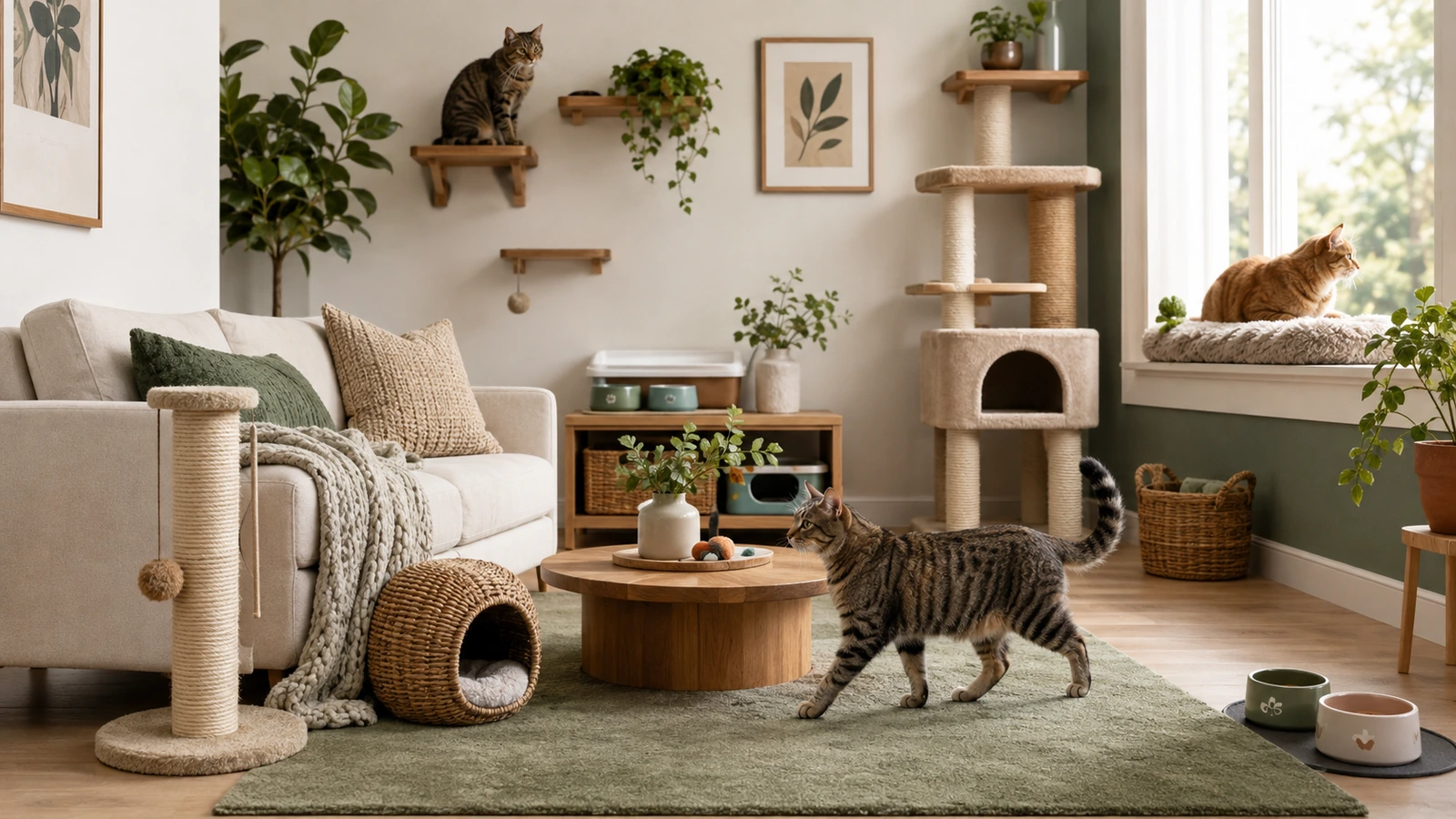
A cat-friendly home is not a house filled with cat-shaped décor. It is a home where your cat can hide, climb, scratch, eat, drink, toilet, play, rest, and interact without unnecessary competition or stress.
That distinction matters. Cats experience a room differently from us. We tend to notice floor space, furniture, and style. A cat also notices escape routes, height, scent, access to resources, the location of other pets, and whether a quiet resting place can be reached without crossing a busy area.
The good news is that you usually do not need a major renovation. A few well-placed resources can make a small apartment more cat-friendly than a large home where everything a cat needs is crowded into one corner.
The American Association of Feline Practitioners and International Society of Feline Medicine organize feline environmental needs around five broad principles: safe places; multiple and separated key resources; opportunities for play and predatory behavior; positive, predictable human interaction; and an environment that respects the cat’s sense of smell and other sensory needs.
Read the AAFP/ISFM feline environmental needs guidance

Quick answer: To make your home cat-friendly, give your cat more than one safe place to rest, provide useful vertical territory, position scratching surfaces where they naturally scratch, separate food, water, litter and resting resources, add daily play and hunting-style enrichment, remove household hazards, and make sure each cat can reach important resources without being blocked by another pet.

1. Start With Safe Places, Not More Stuff
Before buying another toy or cat tree, ask a simpler question:
Where can your cat go when they do not want to interact?
Cats often use hiding and height as ways to feel secure. International Cat Care recommends access to both private places and high resting areas, while Cat Friendly Homes notes that elevated spaces can increase usable territory and help a cat monitor the environment.
International Cat Care: Making your home cat friendly
A safe place can be:
- a covered cat bed;
- an open cardboard box in a quiet corner;
- a shelf your cat can reach easily;
- a cat-tree platform;
- a window perch;
- space beneath a bed;
- a chair or bench with an enclosed retreat beneath it.
The important part is choice. Your cat should be able to retreat without being pulled out, followed, or cornered.
If your cat hides during visitors, loud noises, or household changes, do not assume the hiding place is a problem. Hiding can be a useful coping strategy. Our guide to understanding cat body language can help you tell the difference between relaxed resting, uncertainty, and signs that your cat may be overwhelmed.
Think about escape routes
A beautiful cat cave is less useful if another cat or dog can sit directly outside its only exit.
When possible, place important resting areas so your cat can see what is approaching and leave without squeezing past another pet. This becomes especially important in multi-cat homes.
2. Add Vertical Territory
Floor area is only part of your cat’s usable world.
Shelves, perches, furniture tops, window seats, and cat trees can turn unused wall height into meaningful territory. Elevated positions can provide observation, rest, distance from dogs or children, and another way to move through a room.
You do not need to cover an entire wall with expensive cat furniture.
Start with the routes your cat already tries to use:
- Does your cat sit on the back of the sofa to look outside?
- Do they repeatedly jump onto a bookcase?
- Do they choose the highest platform on a cat tree?
- Do they try to reach a particular windowsill?
Build around that behavior.
Make vertical routes usable
A shelf only works if your cat can get onto it and back down safely.
Consider:
- stable landing surfaces;
- enough depth for the cat to turn around;
- non-slip covering if a surface is slick;
- sensible spacing between levels;
- secure mounting;
- an easier route for kittens, senior cats, or cats with mobility limitations.
For an older cat, a lower perch reached by steps may be more valuable than an impressive floor-to-ceiling climbing wall.
3. Put Scratching Surfaces Where Scratching Happens
Scratching is normal cat behavior. It helps with claw maintenance, stretching, scent marking, and communication.
A common design mistake is hiding the scratching post in an unused corner because it looks tidier there.
Instead, put a suitable scratcher where your cat already wants to scratch—often near a sleeping area, doorway, prominent route, or piece of furniture.
Offer different orientations if you are unsure of your cat’s preference:
- a tall, stable vertical post;
- a horizontal cardboard scratcher;
- an angled scratching board.
The post should not wobble when your cat stretches against it.
If your cat already targets the sofa or carpet, see our complete guide to stopping cat scratching furniture without punishment.
The goal is not to hide all scratching equipment. It is to make the approved scratching surface more useful than the furniture.
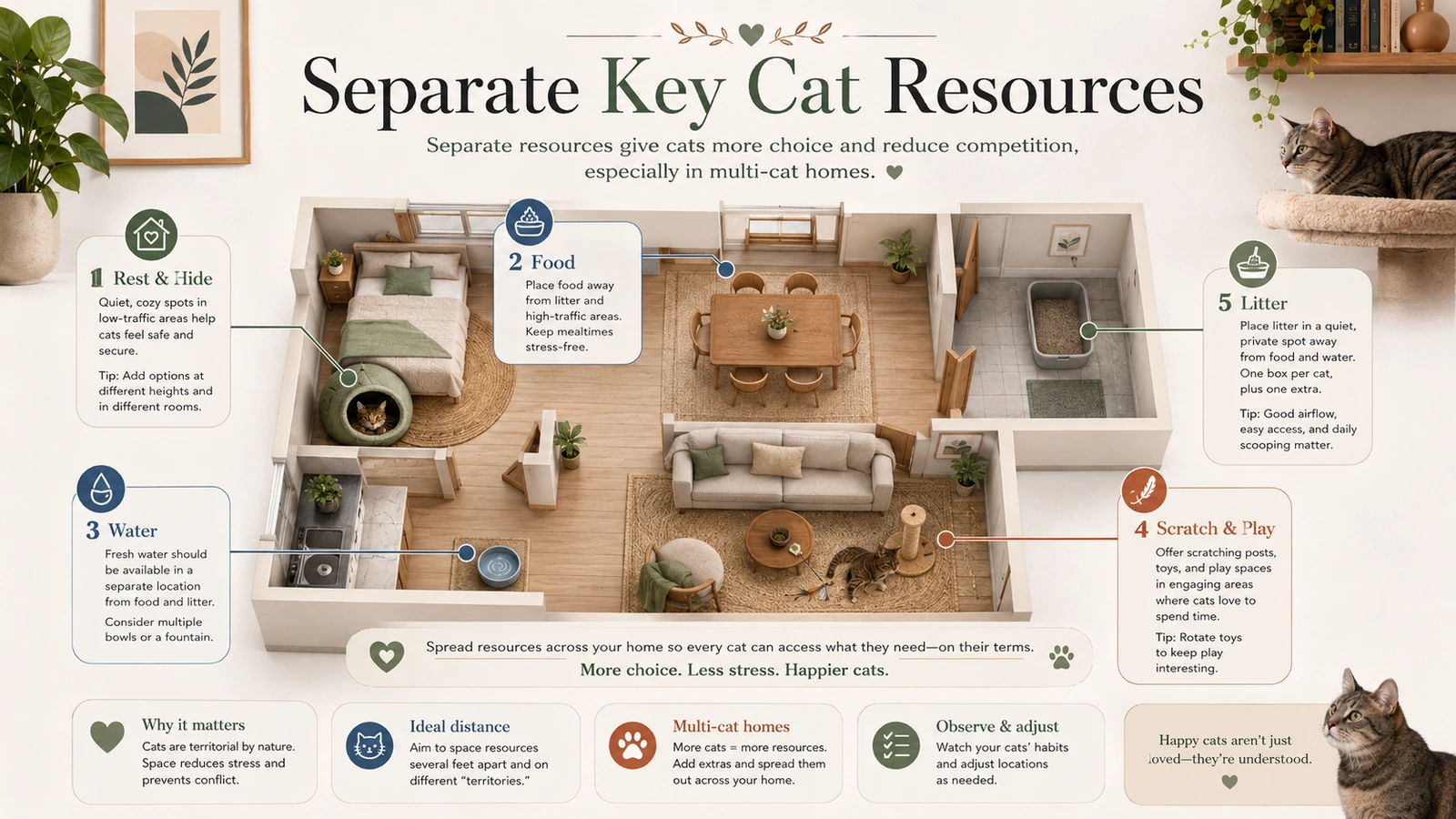
4. Separate Food, Water, Litter, Resting and Play Areas
One of the biggest improvements you can make is also one of the least expensive: stop placing every cat resource together.
The feline environmental needs guidelines recommend separating key resources such as toileting, food, water, resting, scratching, and play areas. Separation gives cats more usable territory and can reduce competition.
For example, avoid creating one small “cat station” containing:
- food;
- water;
- litter box;
- bed;
- scratching post
all within a few feet of one another.
Instead, spread resources through the home where practical.
Food
Choose a location where your cat can eat without feeling exposed or being disturbed by another animal.
In multi-cat homes, watch whether one cat routinely finishes first and then approaches another cat’s bowl. Separate feeding positions can make meals calmer.
Water
Offer fresh water in an accessible location and consider providing more than one water station.
Some cats prefer water away from their food. International Cat Care and Cat Friendly Homes both recommend providing multiple water resources, particularly in multi-cat homes.
Litter boxes
Cat Friendly Homes currently recommends the general rule of one litter box per cat plus one extra, placed in different locations.
Cat Friendly Homes: Everything you should know about litter boxes
That means two cats would generally have three boxes—not three trays lined up beside one another.
Choose locations that are:
- quiet;
- easy to reach;
- away from food and water;
- not beside a noisy appliance;
- not in a place where another pet can block the entrance or exit.
If you use an automatic litter box, our guide to helping your cat transition to a Litter-Robot explains how to introduce the change gradually.
5. Create Daily Opportunities to Hunt, Chase and Play
Indoor life is safer from many outdoor hazards, but the home still needs to give a cat opportunities to perform normal feline behaviors.
Cats Protection notes that indoor cats need opportunities to express natural behaviors such as climbing, hiding, scratching, exploring, and playing.
Cats Protection: Guide to indoor cats
Useful enrichment can be simple:
- a wand toy moved like prey;
- small toys your cat can bat and chase;
- cardboard boxes;
- paper bags with handles removed;
- tunnels;
- a few pieces of food hidden around a safe room;
- puzzle feeders;
- rotated toys rather than every toy left out permanently.
Make play interactive
For many cats, short interactive play sessions are more engaging than simply leaving toys on the floor.
Move a wand toy away from your cat, pause behind furniture, change speed, and allow successful catches. End while your cat is still interested rather than exhausting them.
Never use your hands or feet as prey.
Let your cat choose
Not every cat enjoys the same activity. Some like vigorous chasing; others prefer watching, stalking slowly, food puzzles, climbing, or exploring boxes.
Use your cat’s behavior as feedback rather than assuming a particular toy “should” be entertaining.
6. Turn Windows Into Safe Observation Areas
A window can provide changing visual stimulation without taking up much floor space.
If your cat already watches outside, make the area comfortable with:
- a stable window perch;
- a cat tree positioned nearby;
- a padded bench;
- a cleared section of a wide windowsill.
The key word is safe.
Use secure screens where windows open, and do not assume an ordinary insect screen will withstand a cat pushing or climbing against it. Balcony access should also be securely enclosed if there is any risk of a fall or escape.
If your cat genuinely enjoys outdoor exploration, a secure catio or carefully introduced harness may be an option. See our gentle guide to leash training a cat before assuming every indoor cat will enjoy walks.
7. Make the Home Safe for Curious Cats
A cat-friendly home needs enrichment, but it also needs hazard control.
Be extremely careful with lilies
True lilies and daylilies are especially dangerous to cats. The U.S. Food and Drug Administration warns that the stem, leaves, flowers, pollen, and even vase water can be dangerous, and small exposures can lead to severe kidney injury.
FDA: Lovely lilies and curious cats—a dangerous combination
Do not rely on putting a toxic lily on a “high shelf.” Pollen can fall, cats climb, and vase water can be reached.
Before bringing a plant or bouquet into a cat household, check the species against a reputable toxicity database such as the ASPCA’s plant list.
ASPCA: Toxic and non-toxic plants for cats
Secure cords and strings
Look for:
- dangling blind cords;
- electrical cables a cat repeatedly chews;
- loose thread, ribbon, yarn, or dental floss;
- small objects that could be swallowed;
- unstable lamps or décor near favorite climbing routes.
Interactive string toys should be stored after supervised play rather than left available for chewing.
Store chemicals and medicines securely
Cleaning products, medicines, pesticides, and other household chemicals should be stored where pets cannot access them.
Do not use essential oils or strongly scented products around cats simply because a social-media post describes them as “natural.” Natural does not automatically mean safe.
8. Design for More Than One Cat
A multi-cat home is not automatically a socially unified group.
Some cats sleep together and groom one another. Others simply share an address while maintaining separate preferred spaces.
Resource placement should work for both situations.
Provide multiple:
- feeding places;
- water points;
- litter boxes;
- scratching areas;
- resting places;
- elevated perches;
- hiding spots.
International Cat Care advises positioning duplicated resources in different locations rather than grouping them together.
International Cat Care: Multi-cat households
Watch for subtle blocking rather than waiting for a fight. One cat sitting in a hallway, doorway, stair landing, or beside a litter box may be enough to make another cat avoid the resource.
Signs that your layout needs adjustment can include:
- one cat always waiting for another to leave;
- staring or stalking around resources;
- a cat abandoning a favorite room;
- litter-box avoidance;
- hiding more than usual;
- conflict around food;
- repeated chasing from resting areas.
9. Make a Small Apartment Cat-Friendly
A cat does not measure territory only in square feet.
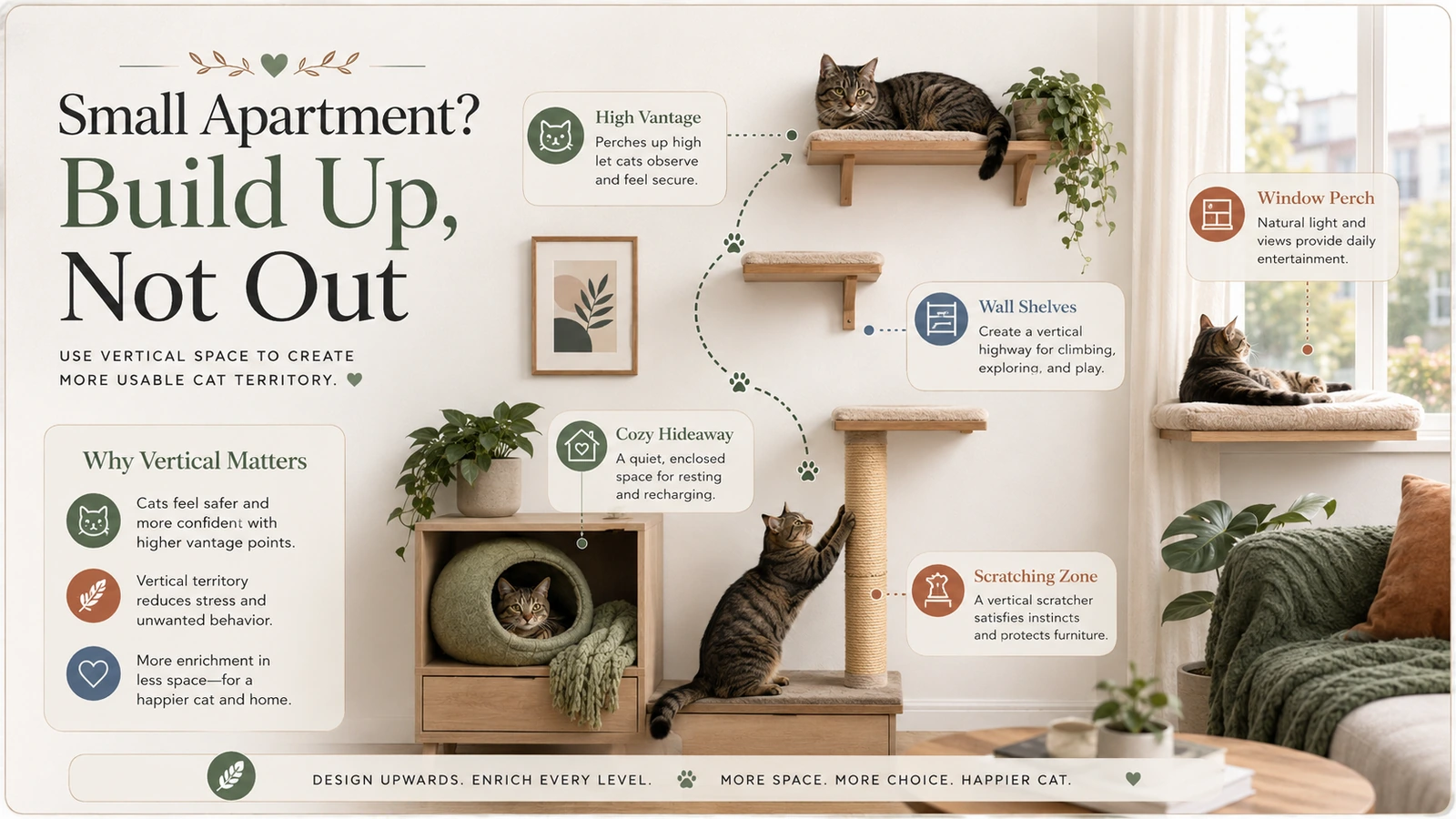
A small apartment can provide a surprisingly rich environment when you use vertical space and distribute resources thoughtfully.
Try:
A slim vertical cat tree
A tall tree with a modest footprint can provide scratching, climbing, resting, and viewing space in one area.
Wall-mounted routes
Well-secured shelves can create a path across unused wall space.
Do not make every platform decorative and tiny. Your cat needs stable places to land, turn, and rest.
Window furniture
A window perch turns an existing feature into an observation area.
Dual-purpose furniture
A bench can provide human seating above and a quiet cat hideaway below.
A side table can shelter a bed underneath.
Storage furniture can keep toys organized without removing them from easy rotation.
Collapsible enrichment
Tunnels and play tents can be opened for play sessions and stored afterward.
Keep pathways open
Do not fill every remaining corner with pet gear. Cats also need predictable routes through the home, particularly if more than one animal lives there.
10. Adapt the Home as Your Cat Ages
A home that worked perfectly for a five-year-old cat may become difficult at fifteen.
Arthritis and reduced mobility can make jumping, stairs, slippery floors, and high litter-box entries more challenging.
Cat Friendly Homes recommends adapting resources for older cats by improving access, adding low-entry litter boxes, using steps or ramps, and keeping food, water, litter, and resting resources close to the areas where the cat spends time.
Cat Friendly Homes: Home modifications for your cat
Consider:
- a low-entry litter box;
- litter boxes on the same floor where your senior cat spends most of their time;
- stable steps to a favorite sofa or bed;
- lower window perches;
- non-slip runners on slick flooring;
- warm, padded resting places;
- food and water positioned for easy access.
A sudden refusal to jump, use stairs, enter a litter box, or visit a previously loved perch can indicate pain or illness rather than a preference for new furniture. Discuss persistent changes with your veterinarian.
11. Keep the Home Stylish Without Hiding What Your Cat Needs
Cat-friendly design and attractive design are not opposites.
The mistake is prioritizing appearance so strongly that the cat resource stops working.
For example:
- A hidden litter cabinet may look elegant but can be unsuitable if it is cramped, poorly ventilated, difficult to clean, or easy for another cat to guard.
- A minimalist scratching post is useless if it wobbles or is too short for your cat to stretch.
- A beautiful floating shelf is not useful if the landing surface is slippery.
- A decorative cat bed does not become a safe retreat if it sits in the busiest part of the house.
Start with function, then choose materials and colors that fit your home.
Useful design approaches include:
- matching a sturdy cat tree to your room’s wood tones;
- choosing neutral scratching furniture;
- integrating a window perch into an existing bench;
- using washable baskets for toy storage;
- installing cat shelves that visually match ordinary shelving;
- selecting litter furniture only when it still provides enough space, ventilation, access, and escape options.
Your cat does not need the house to look like a pet store. They need the important resources to work.
A Room-by-Room Cat-Friendly Home Checklist
Living room
- [ ] At least one comfortable resting area
- [ ] A useful scratching surface near the places your cat spends time
- [ ] Access to height or a window view
- [ ] Stable furniture and secured cords
- [ ] Space for interactive play
Bedroom
- [ ] A quiet rest or hiding option
- [ ] Easy access for senior cats if they sleep on the bed
- [ ] No loose string, ribbon, medication, or hazardous small items within reach
Kitchen and dining area
- [ ] Food placed somewhere the cat can eat without being harassed
- [ ] Water available away from the litter area
- [ ] Cleaning products, dangerous foods, and medicines secured
Litter area
- [ ] Quiet and easy to reach
- [ ] Not beside food or water
- [ ] Easy entry and exit
- [ ] Enough boxes for the household
- [ ] Regular scooping and cleaning
- [ ] Low-entry option if mobility is reduced
Hallways and transition spaces
- [ ] Important resources are not placed where another animal can block access
- [ ] Vertical routes do not create dangerous jumping gaps
- [ ] Cats have more than one route away from busy areas where possible
What Should You Buy First?
If your budget is limited, prioritize function over novelty.
For many homes, the highest-value upgrades are:
- a stable scratching surface that matches your cat’s preferred orientation;
- an additional litter box in a useful location if resources are limited;
- a safe elevated perch or cat tree;
- an additional water station;
- an interactive wand toy;
- a quiet hiding/resting option.
Watch what your cat actually uses before buying more.
A cardboard box in the right location can be more valuable than an expensive bed your cat ignores.
Frequently Asked Questions
What makes a home cat-friendly?
A cat-friendly home gives a cat safe places, separated key resources, opportunities to climb and scratch, appropriate litter-box access, daily play or hunting-style enrichment, positive social interaction, and the ability to retreat when they want space.
Do indoor cats need vertical space?
Most cats benefit from access to elevated resting or observation areas. Vertical space can increase usable territory, provide distance from household activity, and be especially valuable in small homes. The height and access route should suit the individual cat’s age and mobility.
How many litter boxes should I have?
Cat Friendly Homes uses the general guideline of one litter box per cat plus one extra, positioned in different locations. Individual households may need adjustments, but putting several boxes side by side does not provide the same spatial separation.
Should cat food and water be beside each other?
They do not have to be. Feline environmental guidance encourages separation of important resources, and some cats prefer drinking stations located away from feeding areas. At minimum, keep food and water away from litter boxes.
Is a litter-box enclosure cat-friendly?
It depends on the enclosure and the cat. An enclosure should be large enough, easy to enter and exit, well ventilated, easy to keep clean, and positioned where another animal cannot trap or guard the cat inside. Some cats prefer uncovered open trays.
How can I make a rental apartment cat-friendly without drilling holes?
Use a freestanding cat tree, window perch suited to your window, stable scratching posts, cardboard scratchers, boxes, tunnels, removable furniture arrangements, and strategically placed resting areas. Always check rental rules before mounting hardware.
How do I know whether my cat likes the changes?
Watch behavior. A useful environmental change is one your cat voluntarily uses while remaining relaxed. If your cat avoids the area, crouches, freezes, hides more, or stops using a resource, reassess the setup rather than forcing interaction.
The Bottom Line
A cat-friendly home is built around choice.
Give your cat somewhere to hide and somewhere to climb. Separate important resources. Put scratching surfaces where scratching naturally happens. Make litter boxes easy to reach and difficult for other pets to guard. Provide daily opportunities to chase, explore, and play. Remove hazards rather than relying on your cat to ignore them.
Then observe.
Your cat’s habits will tell you which parts of the home are working and which need adjustment. The best design is not the one with the most cat furniture—it is the one that allows your cat to move through everyday life feeling secure, capable, and in control.