

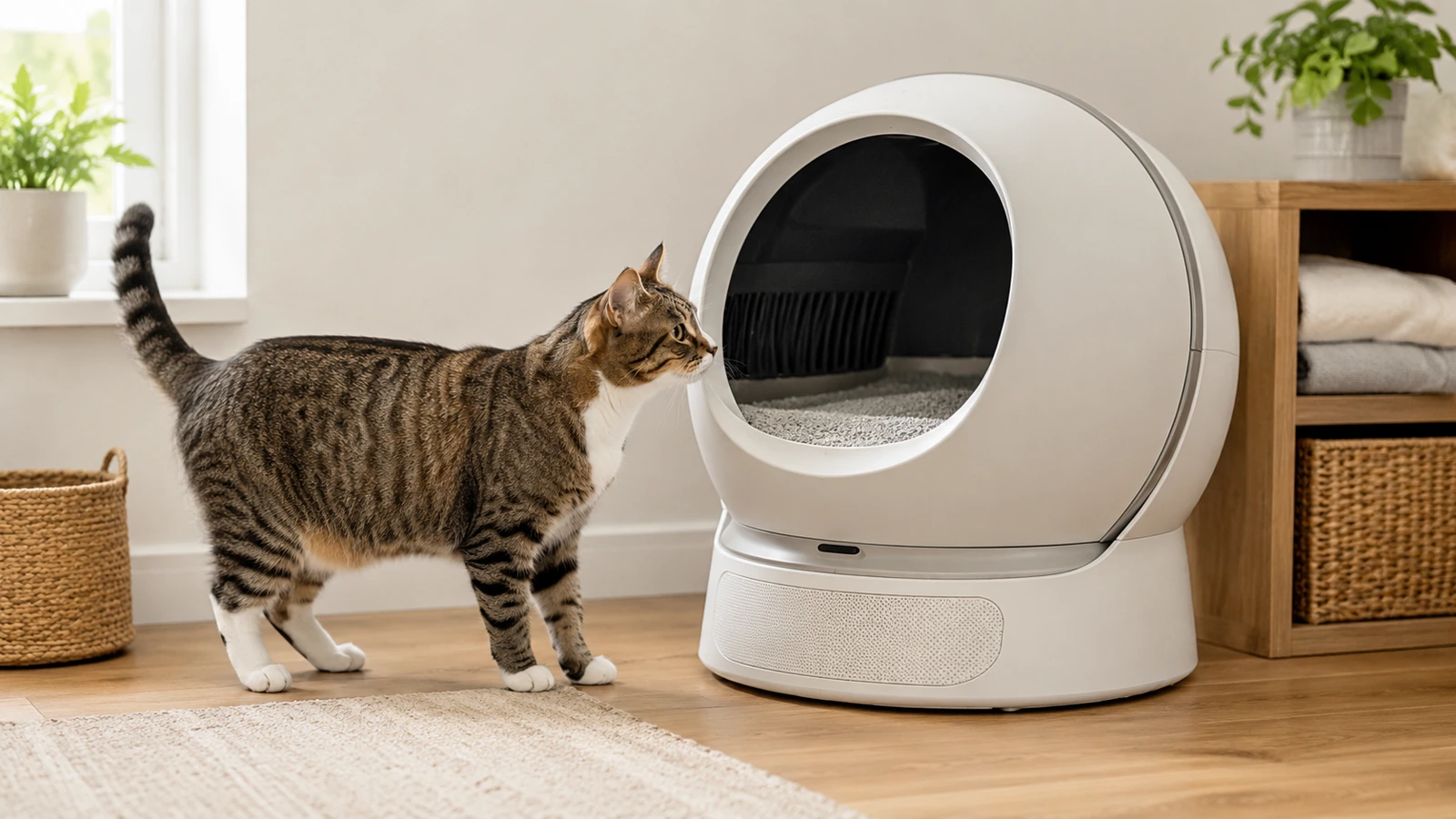
A Litter-Robot can make litter-box maintenance easier, but your cat does not know that when a large new machine appears beside the familiar tray. To your cat, the change may involve a different shape, entry height, smell, sound, movement, and litter surface—all at once.
The best way to help a cat use a Litter-Robot is therefore not to “train” them by placing them inside or removing every alternative. It is to make the new box familiar, keep the transition predictable, and let your cat choose to investigate and use it.
For many cats, the process is quick. Others need days or several weeks. Whisker, the manufacturer of Litter-Robot, recommends beginning with the unit switched off, keeping the old litter box during the transition, using familiar compatible litter, and introducing the automatic cycle gradually once the cat is using the new box.
Quick answer: Put the Litter-Robot near your cat’s existing litter box, leave it powered off at first, keep the litter familiar, reward calm voluntary investigation, and wait for reliable use before introducing automatic cycling. If your cat begins urinating or defecating outside the box, restore an acceptable litter option and investigate the reason rather than punishing them.
Before You Start: Make the Transition Easy
A cat is more likely to accept a new litter box when you avoid changing several things at the same time.

Check your exact Litter-Robot model
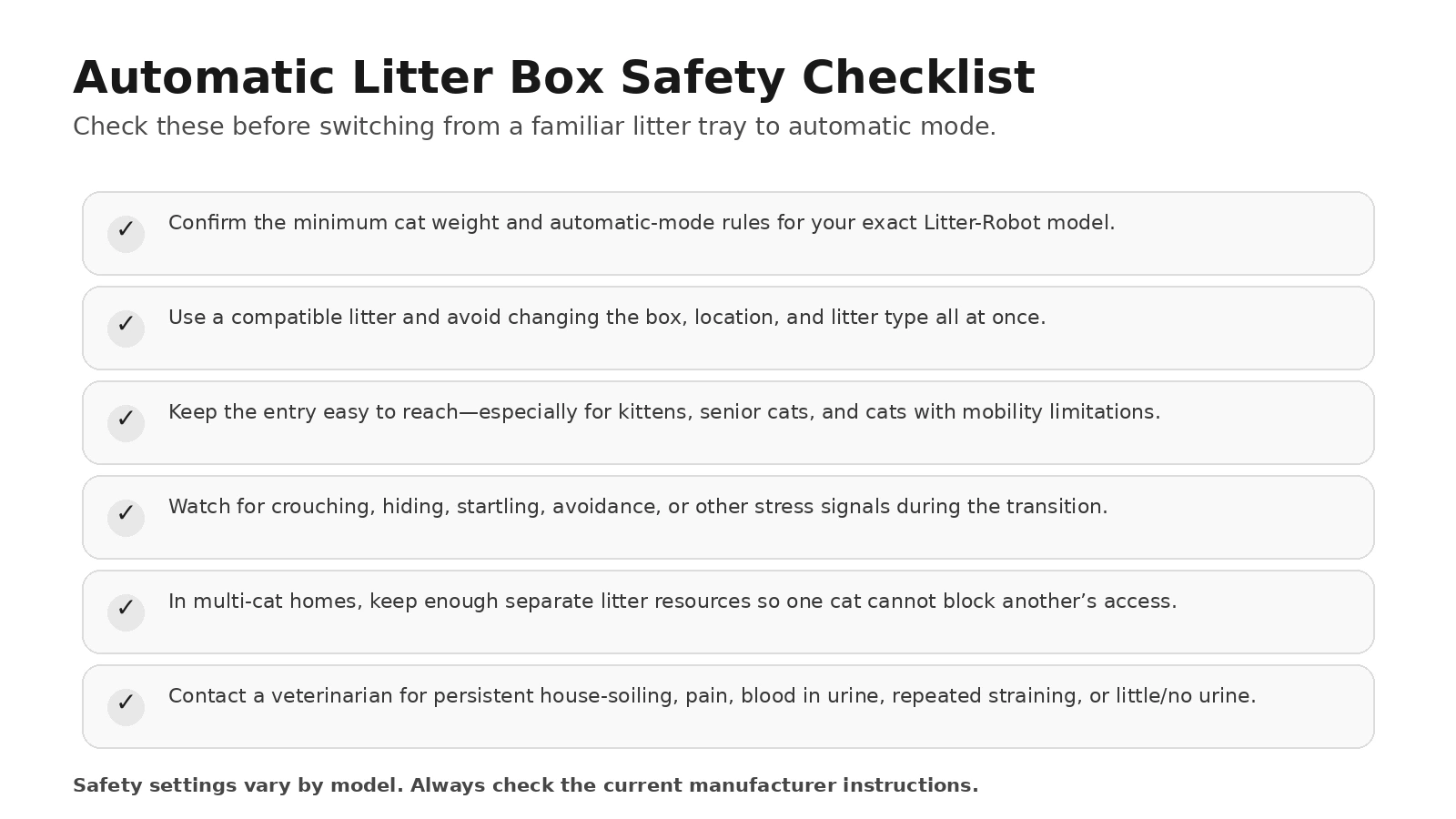
Safety settings and minimum weight requirements vary by model. For example, Whisker’s current guidance states that cats need to weigh at least 3 lb (1.36 kg) for Litter-Robot 4 automatic mode and at least 5 lb (2.27 kg) for Litter-Robot 3 automatic mode. Always check the current manual or support page for your specific model before using automatic mode with a kitten or very small cat.
Check current Litter-Robot acclimation and model guidance
Keep the litter familiar
Do not change the litter box, the litter type, and the location all at once if you can avoid it. Litter-Robot works with many clumping litters, but not every litter type is compatible. Whisker advises using a compatible clumping litter and notes that some non-clumping, loose-clumping, newspaper-based, and wood-pellet litters are unsuitable.
If your cat’s current litter is compatible, use it during the transition. If it is not, change the litter gradually before—or separately from—the switch to the automatic box.
See Whisker’s current litter compatibility guidance
Choose a quiet, accessible location
Cats generally prefer litter boxes in quiet places where they can enter and leave easily. Avoid trapping the new unit in a busy passageway, beside loud appliances, or in a location where another pet can block access.
In a multi-cat home, remember that a self-cleaning box may be able to handle waste from several cats, but that does not necessarily mean every cat will be comfortable sharing one toileting resource. Cat Friendly Homes recommends multiple litter boxes in separate locations, with the general guideline of one box per cat plus one additional box.
Read Cat Friendly Homes’ litter-box guidance
How to Get Your Cat to Use a Litter-Robot in 7 Steps
1. Place the Litter-Robot Beside the Old Litter Box
Start in familiar territory. If possible, place the Litter-Robot close to the location where your cat already toilets comfortably.
Keep the old litter box available. Removing it on day one may leave a cautious cat without an acceptable option and can make the transition more stressful.
If the two boxes cannot fit in exactly the same place, choose a nearby quiet, accessible location. Avoid moving the old box far away at the same time that you introduce the new one.
2. Leave the Litter-Robot Turned Off
This is one of the most important steps.
A cat that has never seen an automatic litter box may accept the shape and litter but become frightened when the globe suddenly moves. Whisker recommends leaving the unit switched off during the first stage of acclimation.
Let the Litter-Robot behave like an ordinary stationary litter box while your cat learns that it is safe.
Do not repeatedly run cleaning cycles just to show your cat how the machine works. The movement can come later, after your cat is comfortable approaching and using it.
3. Add Familiar Litter and Scent
Fill the Litter-Robot with a compatible litter your cat already knows whenever possible.
Whisker also recommends adding a small scoop of litter from the old box to the Litter-Robot. The familiar scent can help communicate the purpose of the new object without physically placing your cat inside.
Avoid putting food directly in the litter bed. If you use treats, place them on the step or around the outside of the unit, as recommended by the manufacturer.
4. Reward Voluntary Investigation
Let your cat approach on their own.
A sniff, a paw on the step, looking inside, or calmly standing near the entrance can all be useful early progress. Pair those voluntary interactions with something your cat enjoys, such as a small treat, a short play session, or calm attention.
Do not push, carry, or hold your cat inside the globe. Forcing a frightened cat into a litter box can create a negative association with a place you need them to feel safe using.
If your cat backs away, crouches, hides, freezes, or startles, reduce the pressure. Give them more time and try again later.
Our guide to understanding cat body language can help you distinguish curiosity from discomfort during the transition.
5. Wait for Your Cat to Use It Voluntarily
The first real goal is not automatic cleaning. It is voluntary toileting.
Continue offering both the familiar box and the powered-off Litter-Robot while your cat investigates. Some cats may use the new box immediately; others need repeated exposure before they are willing to enter.
Once your cat urinates or defecates in the Litter-Robot, resist the urge to rush ahead. Several calm, voluntary uses give you much better evidence that the cat accepts the box itself.
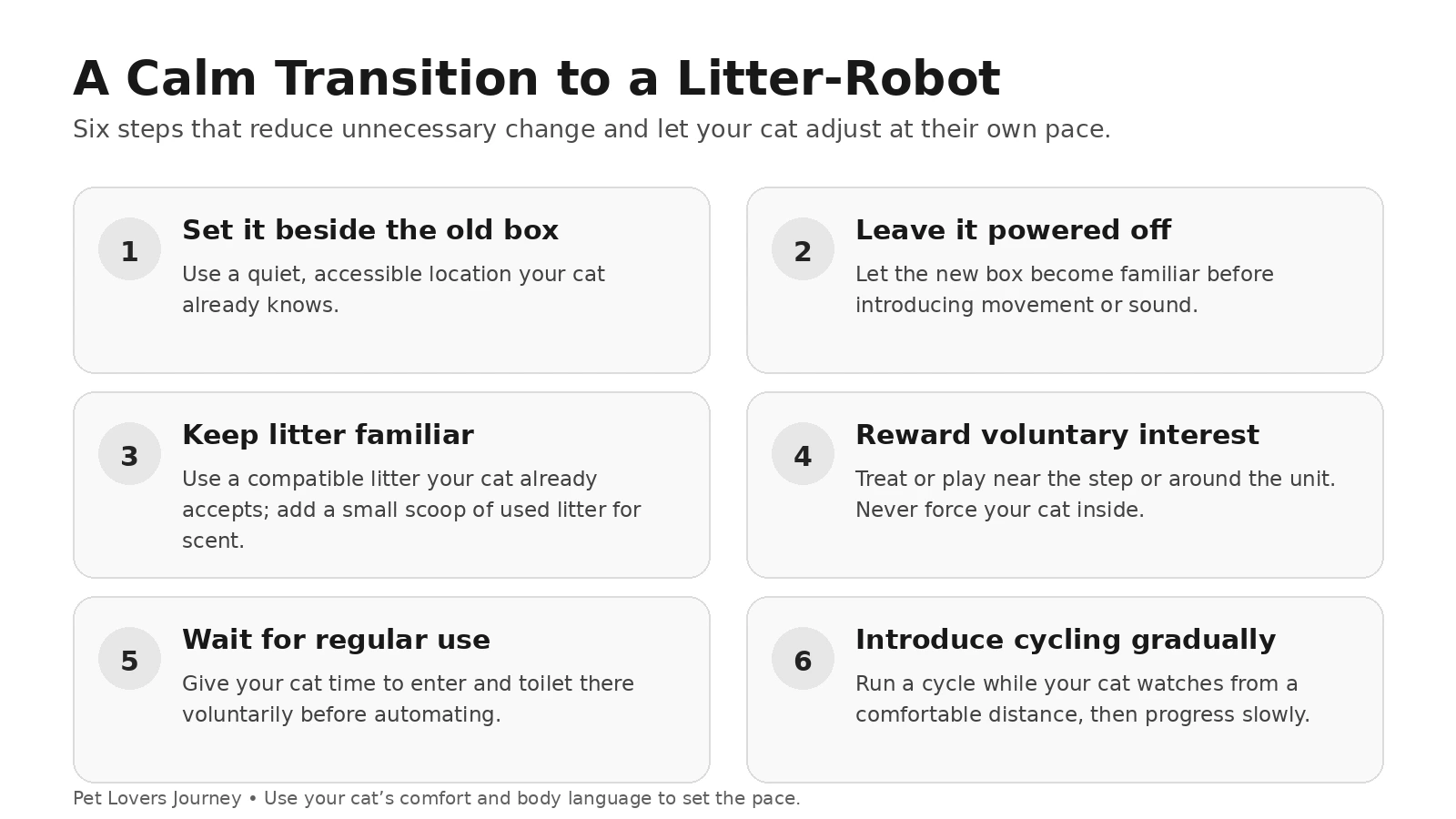
6. Introduce the Cleaning Cycle Gradually
When your cat is using the Litter-Robot regularly, introduce movement.
Run a cleaning cycle while your cat is at a comfortable distance and able to leave. Stay calm and let them watch. If your cat observes without obvious distress, that is a good sign.
If they bolt, hide, refuse to return to the area, or stop using the box, go back to the powered-off stage.
Some models allow you to extend the delay before an automatic cycle begins. A longer delay can be useful for a cautious cat because it creates more time between toileting and movement. Follow the instructions for your exact model.
Never use automatic mode with a kitten below the manufacturer’s stated minimum weight for that model.
7. Retire the Old Box Only After the New Routine Is Reliable
Do not remove the old litter box simply because your cat used the Litter-Robot once.
Wait until your cat has shown a consistent preference or reliably uses the Litter-Robot over time. The exact timeline varies by cat.
Whisker suggests keeping both boxes during acclimation and gradually making the old box less attractive. From a cat-welfare perspective, however, do not allow the old litter box to become heavily soiled or unusable. Cats need clean, acceptable toileting options, and a dirty box can itself contribute to house-soiling.
When you are confident that your cat has accepted the new setup, remove the old box gradually rather than making several environmental changes at once.
How Long Does It Take a Cat to Get Used to a Litter-Robot?
There is no universal schedule.
Whisker says many cats begin using Litter-Robot within several days to a week, while some take several weeks or longer. Treat that as a general manufacturer estimate, not a deadline for your cat.
Progress is more important than speed.
A cautious cat that calmly sniffs the unit on day three may be making better progress than a cat that was placed inside on day one and now avoids the entire room.
If your cat is relaxed, eating normally, toileting normally, and gradually becoming more comfortable, you can continue at their pace.
What If Your Cat Won’t Use the Litter-Robot?
First identify where the transition is failing.
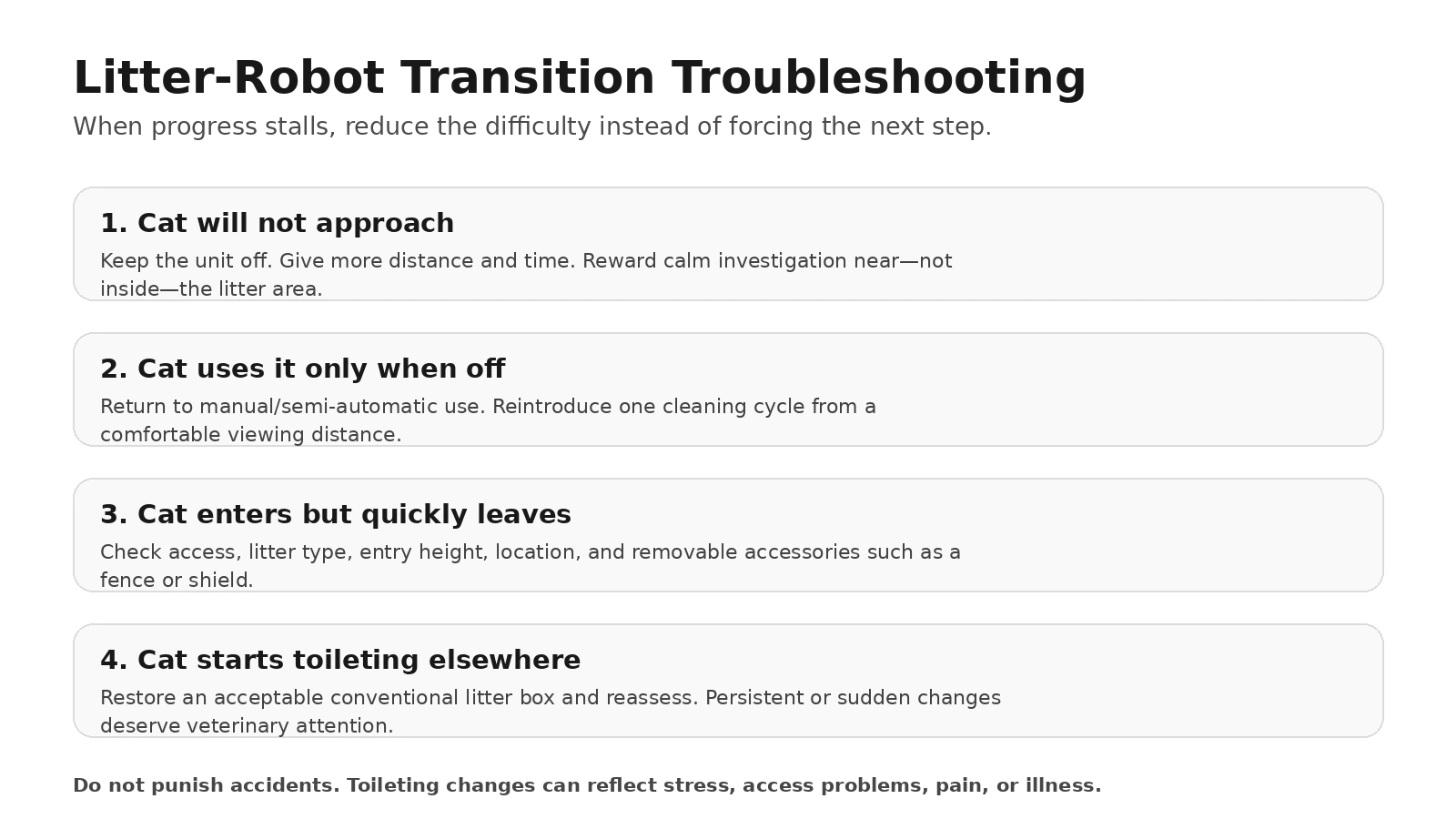
| What your cat does | What to try |
|---|---|
| Will not approach the unit | Keep it off, reduce pressure, allow more time, and reward calm investigation nearby. |
| Approaches but will not enter | Check the entry height, location, litter type, and whether removable accessories are making the opening feel restrictive. |
| Uses it only when powered off | Return to manual or semi-automatic use and reintroduce one cleaning cycle from a safe viewing distance. |
| Used it once, then stopped | Look for a frightening cycle, litter change, noisy location, access issue, or another pet blocking the area. |
| Toilets beside the unit | Restore a familiar acceptable box, clean the accident with an appropriate enzymatic cleaner, and reassess the setup. |
| Suddenly stops using all litter boxes normally | Contact your veterinarian rather than assuming the problem is behavioral. |
Do Not Punish Litter-Box Accidents
A cat that urinates or defecates outside the Litter-Robot is not being spiteful.
House-soiling can result from the litter box itself, its location, social tension, fear, pain, urinary disease, digestive problems, mobility limitations, or other medical issues. Cat Friendly Homes specifically notes that toileting outside the box can reflect physical, social, environmental, or medical needs.
Do not yell, spray water, rub your cat’s nose in an accident, or force them into the Litter-Robot.
Instead:
- Restore an acceptable litter box.
- Clean the accident thoroughly.
- Review the location, litter, access, noise, and recent changes.
- Watch for physical symptoms.
- Contact your veterinarian if the change is persistent, sudden, or accompanied by signs of illness.
Cornell Feline Health Center explains medical and environmental causes of house-soiling
Important Warning: Straining or Producing Little or No Urine Is Not a Training Problem
Repeated trips to the litter box, crying while urinating, blood in the urine, obvious pain, or straining with little or no urine requires prompt veterinary attention.
A urinary blockage can be life-threatening, particularly in male cats. Do not spend days experimenting with litter-box training if your cat appears unable to urinate normally.
Special Considerations for Kittens
Kittens may learn to use an automatic litter box, but automatic cycling must follow the minimum weight requirement for the exact model.
Current manufacturer guidance states:
- Litter-Robot 4: automatic mode from 3 lb (1.36 kg)
- Litter-Robot 3: automatic mode from 5 lb (2.27 kg)
For other models, check the current manual rather than assuming the same limit.
If a kitten is below the safe automatic-mode weight, Whisker recommends operating the unit in a manual or semi-automatic way: keep it powered off during normal use and run a cleaning cycle only when you know the kitten is safely away.
Special Considerations for Senior Cats
An older cat may understand the new litter box perfectly but dislike the physical effort required to enter it.
Arthritis and other mobility problems can make high-sided or elevated litter boxes difficult to use. Consider whether your cat needs:
- a stable ramp or step;
- a non-slip approach;
- a box on the same floor where they spend most of their time;
- an additional low-entry conventional litter box.
If an older cat suddenly begins toileting beside the box, do not assume they are simply refusing the Litter-Robot. Pain, mobility problems, cognitive changes, kidney disease, diabetes, urinary disease, and other medical conditions can affect litter-box use.
What About Multi-Cat Households?
One cat accepting the Litter-Robot does not mean every cat in the home will.
Introduce each cat at their own pace and watch for subtle resource guarding. A timid cat may avoid a litter area if another cat waits nearby, blocks the route, or controls access.
General feline-environment guidance recommends multiple litter stations in separate locations. This remains worth considering even when the manufacturer states that one automatic unit can physically accommodate waste from multiple cats.
If one cat consistently avoids the Litter-Robot but toilets normally in another clean box, keeping an alternative box may be better than forcing every cat to share the same setup.
Should You Use a Litter Attractant?
Whisker lists litter attractant as one option for cats that remain hesitant.
It may be worth trying after you have already checked the basics: location, compatible litter, access, noise, cleanliness, and whether the automatic cycle was introduced too quickly.
Introduce any new litter additive gradually. If your cat dislikes the smell or texture, another sudden change can work against your transition.
Frequently Asked Questions
Should I put my cat inside the Litter-Robot?
No. Let your cat enter voluntarily. Placing or holding a reluctant cat inside can make the new box feel threatening and may create avoidance.
Should I turn the Litter-Robot off at first?
Yes. Whisker recommends leaving the unit switched off during the early acclimation stage so movement does not startle your cat. Introduce the cleaning cycle after your cat has begun using the box.
Can I use my cat’s old litter in a Litter-Robot?
If the litter is compatible with your model, keeping the familiar litter can make the transition easier. Whisker also recommends adding a small scoop of used litter to the new box for familiar scent.
When should I remove the old litter box?
Wait until your cat is using the Litter-Robot consistently. Do not remove the familiar box after a single successful use, and do not leave your cat without an acceptable clean toileting option during the transition.
What if my cat is scared of the cleaning cycle?
Turn automatic operation off again and return to the last stage where your cat was comfortable. After regular use resumes, introduce one cycle while your cat watches from a comfortable distance. Increase the cycle delay if your model offers that setting and your cat needs more separation between toileting and movement.
Why did my cat use the Litter-Robot and then stop?
Consider whether something changed: an automatic cycle startled them, the litter changed, the location became noisy, access became difficult, another pet began guarding the area, or the box needs maintenance. A sudden or persistent change in toileting can also have a medical cause, so involve your veterinarian when appropriate.
Can a senior cat use a Litter-Robot?
Some can, but entry height and mobility matter. A ramp or stable step may help, while some senior cats will still prefer a low-entry conventional box. Sudden difficulty entering a litter box can be a sign of pain or reduced mobility.
The Bottom Line
The easiest Litter-Robot transition is usually the one that feels least dramatic to your cat.
Keep the unit still and familiar at first. Preserve an acceptable litter option. Reward curiosity. Wait for voluntary use. Introduce the automated cycle only after the box itself has become part of your cat’s routine.
Most importantly, let your cat’s behavior—not a fixed timetable—tell you when to move to the next step. If toileting changes become persistent or your cat shows signs of pain or difficulty urinating, stop treating the problem as a training issue and contact your veterinarian.