
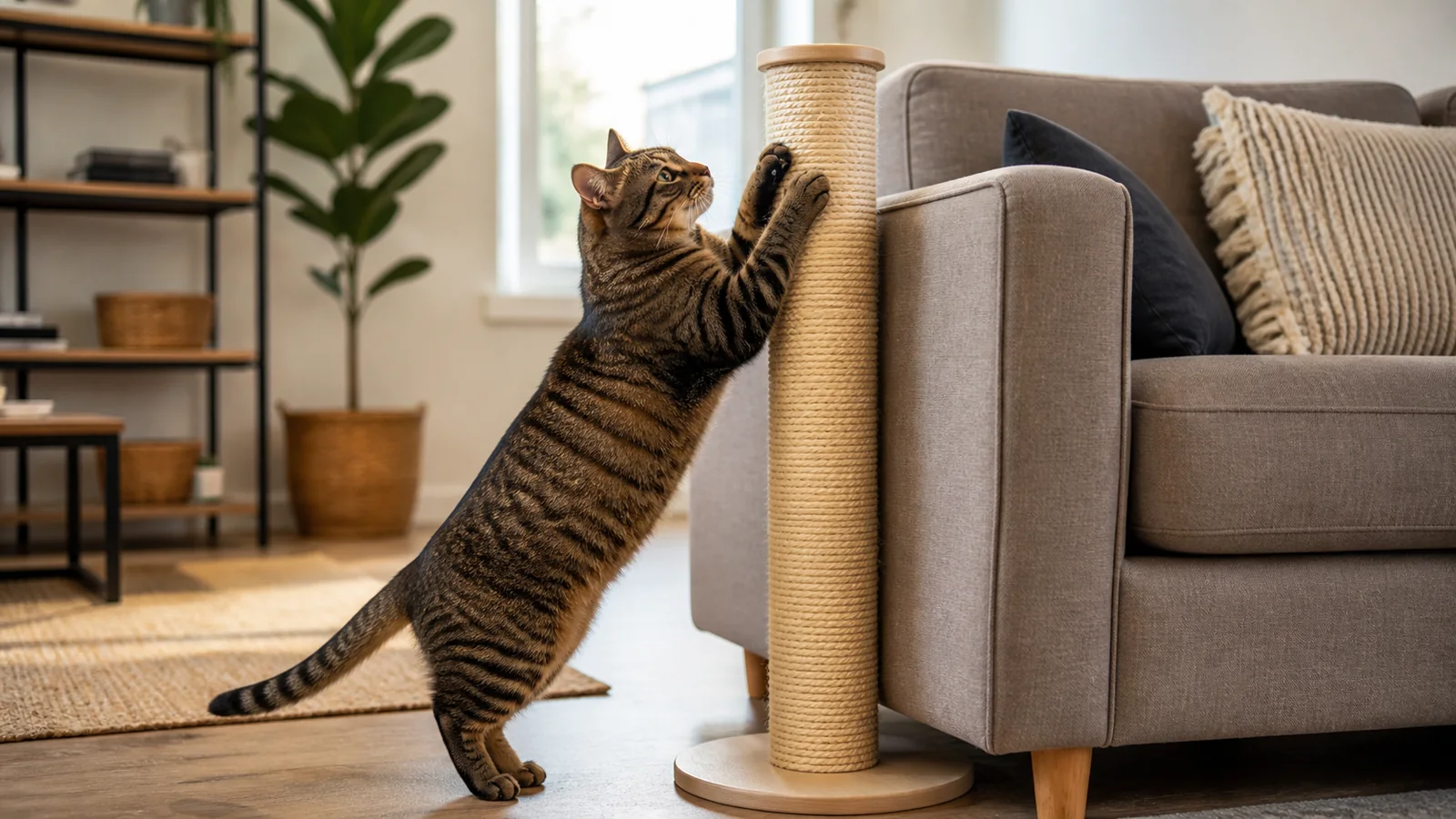
If you’re wondering how to stop cat scratching furniture, do not try to eliminate scratching itself. Match a stable scratching surface to the angle and texture your cat already chooses, put it directly beside the damaged area, cover the furniture temporarily and reward voluntary use of the alternative. Then reassess the setup if the behaviour continues. Scratching is normal feline behaviour, so the humane goal is redirection—not punishment, frightening deterrents or forced paw placement. Never use orange, lemon or other essential oils, or homemade scent sprays, as deterrents.
Why Cats Scratch Furniture
Scratching is not spite or defiance. Cats scratch to stretch, maintain their claws and leave visible and scent marks. It is a normal part of feline behaviour, according to the Feline Veterinary Medical Association’s environmental guidance and Cornell Feline Health Center.
Furniture often meets several feline needs at once. A sofa arm may be tall enough for a full stretch, stable enough not to wobble, covered in a satisfying texture and positioned in a socially important room. A rug offers a horizontal surface underfoot. A chair near a sleeping area may become part of a wake-up stretch-and-scratch routine.
That is why simply buying a scratching post may not work. The post has to compete with the experience the furniture already provides. The practical solution is to match, place, protect, reward and reassess.
How to Stop Cat Scratching Furniture: Read the Pattern First
Before moving furniture or buying another scratcher, observe the pattern for a few days. Note the object, posture, texture, location and timing. In a multi-cat home, also watch whether one cat controls access to a preferred route or resource.
More Read

Cats can prefer different orientations and materials, and those preferences can change with age or mobility. Cat Friendly Homes guidance on living with a clawed cat recommends considering size, stability, texture and location rather than assuming one type of post suits every cat. An owner-reported observational study also found associations between scratching-post features, rewards and where cats scratched, although that survey cannot prove that any one feature caused the behaviour (Wilson et al., 2016).
| Current scratching pattern | Preference to test | First alternative to try | Best starting position |
|---|---|---|---|
| Sofa arm, chair side or doorframe | Vertical, tall, stable and rough | A sturdy post or securely mounted vertical panel that permits a full-body stretch | Directly beside or slightly in front of the damaged area |
| Rug or carpet | Horizontal surface with a similar resistance | A secured horizontal scratching board or pad | Over the preferred spot, or immediately beside it if covering is impractical |
| Sloped furniture edge | Angled support | A stable angled scratcher | On the cat’s usual approach route to the target |
| Scratching immediately after sleep | Stretch-and-scratch routine | Vertical or horizontal surface matched to the cat’s posture | Beside the resting place |
| Several targets or a multi-cat home | Multiple marking or resource locations | Several separated scratching surfaces | Along the cats’ actual living routes, without one cat blocking another |
Step 1: Match the Scratching Surface to Your Cat
Use the existing damage as information.
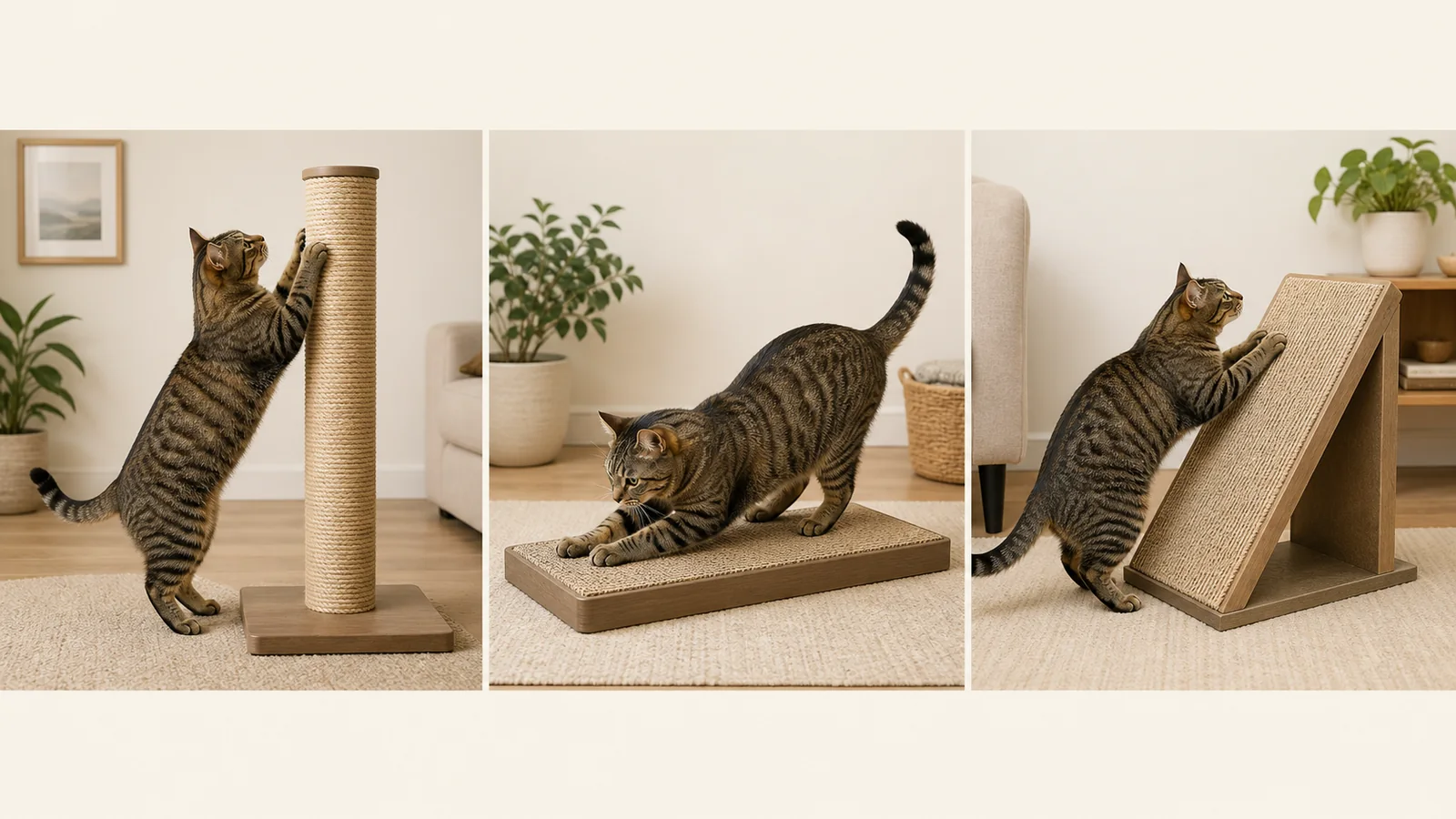
- For vertical scratching: Choose a post or panel that stays firm when the cat leans into it and allows a comfortable full-body stretch. A short or wobbly post may be less appealing than a solid sofa.
- For horizontal scratching: Use a board or pad that will not slide across the floor. If the cat targets a rug, test textures that provide similar resistance without creating loose threads or small detachable pieces.
- For angled scratching: Secure an angled surface so it cannot collapse or tip.
- For texture: Offer a small selection of safe, rough surfaces such as sisal, cardboard or unfinished scratching wood. Do not assume that one material is universally preferred.
- For older cats or cats with limited mobility: Try lower, horizontal or gently angled options that do not require an uncomfortable reach. Ask a veterinarian about new stiffness, reluctance to jump or other mobility changes.
Inspect scratching surfaces regularly. Replace or repair them if they become unstable or develop loose staples, exposed fasteners, long strands or pieces that could be swallowed.
Step 2: Put the Scratcher Where the Behaviour Happens
Location is part of the solution. Put the matched scratcher directly beside the sofa arm, chair, carpet edge or doorframe being used. Veterinary behaviour guidance recommends starting at the cat’s chosen location rather than expecting the cat to cross the room to find a less convenient option (FelineVMA; Cornell Feline Health Center).
Also consider these common locations:
- beside a bed, perch or other resting place if scratching follows sleep;
- along frequently used routes through the home;
- in prominent shared rooms where the cat already leaves marks;
- in separate, accessible areas when several cats share the home.
If a scratcher becomes reliably used and its starting position is inconvenient, move it gradually rather than relocating it across the room at once. Watch whether use continues after each small change.
Step 3: Reward Voluntary Use
Let the cat choose to investigate the scratcher. You can draw attention to it with a toy moved along the surface, then reward any voluntary touch or scratch. Give the reward promptly so the connection is clear. Use what that individual cat values—perhaps a small treat, a brief play session, gentle attention or another familiar reward.
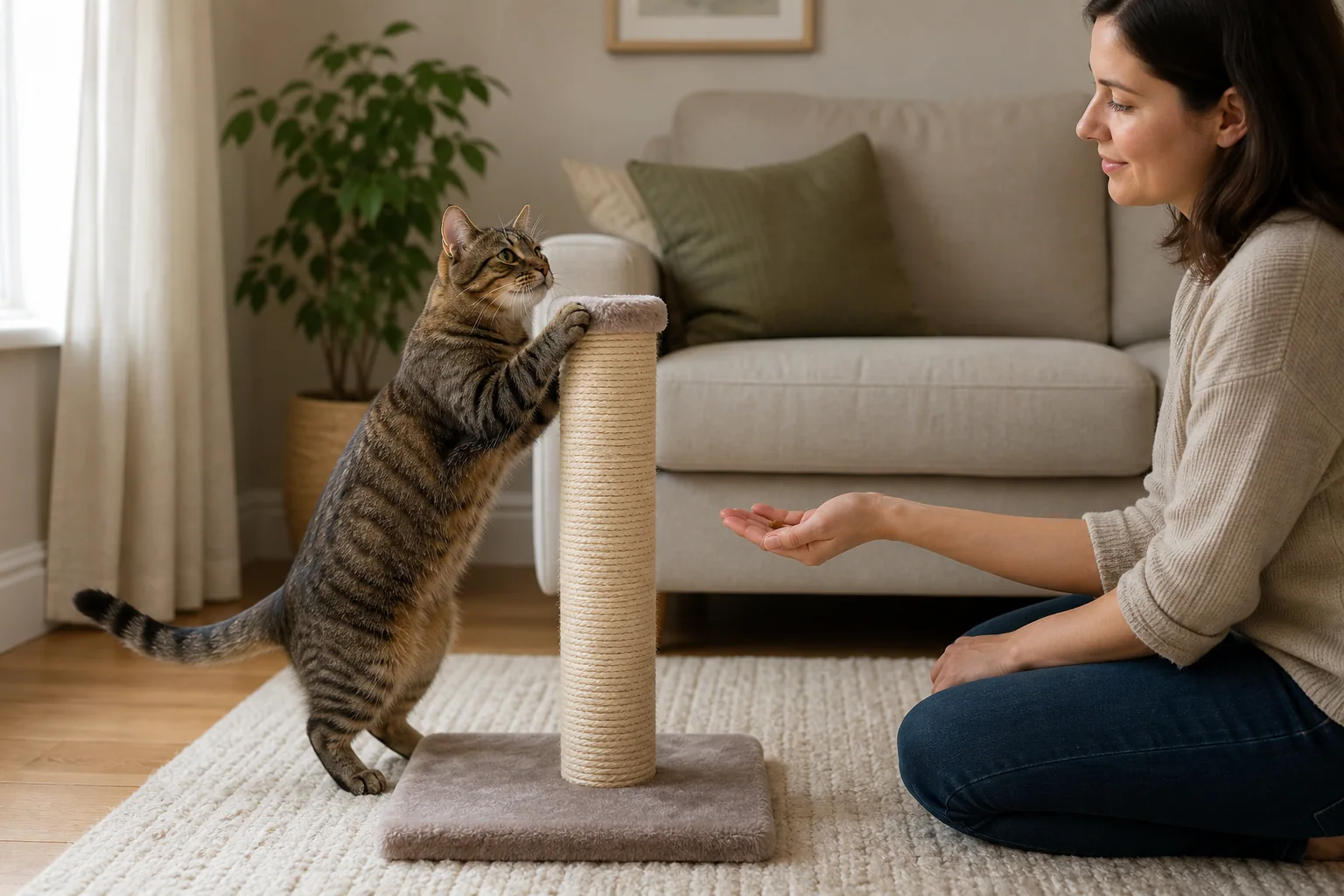
Never rub the cat’s paws on the surface or carry the cat to the post and hold them there. Do not yell, spray water, clap to frighten them or use other punishment. These responses do not teach the desired location and can add distress. FelineVMA recommends rewarding the behaviour you want and avoiding verbal or physical punishment; Cornell likewise cautions that punishment can create fear without solving the scratching need (FelineVMA training guidance; Cornell).
Keep interactions brief and stop before either of you becomes frustrated. For more on building voluntary behaviours, see these reward-based cat training basics.
Step 4: Protect the Furniture During Redirection
Temporary protection prevents further damage while the new surface becomes familiar. Pair every barrier with an acceptable scratcher nearby; blocking the sofa without providing an outlet leaves the cat’s normal need unresolved.
Try the least disruptive physical option that fits the furniture:
- Use a fitted, smooth furniture guard that cannot trap claws or create loose pieces.
- Cover the target with a secure washable throw or fitted cover.
- Restrict access temporarily when the cat is not supervised, provided the cat still has access to food, water, litter, rest, play and scratching resources.
- Secure an appropriate scratching panel over or immediately beside the target.
Check any guard or cover for sharp edges, unstable attachments, loops, loose threads and material incompatibility. If you are planning a wider room change, use the same principle—protect vulnerable areas while making the approved option easier to reach. Our guide to designing a cat-friendly home explains how layout and resource placement can support everyday behaviour.
Essential-oil warning: Do not use orange, lemon or other essential oils—or homemade scent sprays—as cat deterrents. Essential oils can expose cats through the skin, paws, coat, grooming or inhalation, and citrus oils are among those associated with feline poisoning. Use physical furniture protection and reward-based redirection instead. If exposure is suspected or your cat becomes unwell, contact a veterinarian or an animal poison-control service promptly. See the ASPCA’s essential-oil guidance, the Merck Veterinary Manual and Pet Poison Helpline’s cat-specific overview.
Step 5: Reassess Enrichment, Resources and Stress
Scratching may become more noticeable when a cat has too few outlets, when important resources are difficult to access or when the household changes. Environmental support will not eliminate normal scratching, but it can reduce avoidable competition and distress while giving the cat appropriate ways to act.
Review the wider setup:
- provide regular opportunities for stalking, chasing and catching during play;
- offer resting and hiding places in usable locations;
- distribute scratching, resting, feeding, drinking and toileting resources so one cat cannot easily block another;
- observe whether visitors, building work, a move, a new animal or outdoor cats near windows coincide with the change;
- make sure every scratching option is stable, accessible and suited to the cat’s mobility.
The AAFP/ISFM environmental-needs guidelines explain how opportunities for normal behaviour and well-distributed resources support feline welfare. You can also build a broader plan for indoor cat enrichment.
A sudden or marked increase in scratching deserves attention, especially if it appears alongside hiding, appetite or litter-box changes, overgrooming, aggression, vocalisation, sleep changes, pain signs or reduced activity. These observations do not identify a diagnosis. Contact a veterinarian to rule out health problems, and consider a qualified feline behaviour professional if the pattern continues after medical concerns and environmental needs have been addressed. Our guide to signs of stress in cat body language can help you record changes without trying to diagnose them.
Step 6: Reduce Damage With Cat-Friendly Claw Care
Claw care can reduce the damage caused by scratching, but it does not remove the need for scratching surfaces, movement, marking or enrichment.
Nail trimming
Some indoor cats benefit from having only the sharp tips trimmed. How often this is needed varies with the individual cat, their claw growth, activity, health and comfort with handling—there is no single schedule for every cat.
Introduce paw handling gradually when the cat is relaxed. Use minimal restraint, work on as few claws as the cat comfortably allows and stop if they struggle or become distressed. Trim only the sharp tip and avoid the quick, the sensitive tissue inside the claw. If the claw is dark, damaged or difficult to see, or the cat resists handling, ask a veterinarian or experienced cat groomer for help rather than forcing the session. VCA’s cat nail-trimming guide provides a veterinary overview of gradual handling, minimal restraint and avoiding the quick.
Temporary nail caps
Synthetic nail caps may reduce furniture damage temporarily for some cats, but they are a management tool—not training and not a substitute for scratching outlets. They require correct fit and application, regular inspection and replacement as claws grow and caps shed. They are unsuitable when a cat cannot tolerate paw handling or application without significant restraint.
Ask your veterinary team for advice if you are uncertain about fit, application, claw health or whether caps are appropriate for your cat. Stop and seek advice if you notice swelling, pain, limping, damaged claws or persistent licking. Cornell describes plastic caps as a temporary option, while FelineVMA includes temporary synthetic nail caps among alternatives to declawing (Cornell; FelineVMA).
Step 7: Troubleshoot Why the Plan Is Not Working
Change one or two variables at a time and observe the result. The table below starts with the most likely practical checks; it is not a diagnostic tool.
| Problem | What to check | Next humane adjustment |
|---|---|---|
| The cat ignores the post | Orientation, texture, stability or location does not match the chosen furniture | Match the current target more closely and put the alternative directly beside it |
| The cat uses both the post and sofa | The sofa remains an important scratching or marking site | Protect the sofa temporarily and keep or add a scratcher at that exact site |
| Scratching happens after sleep | No suitable surface is available at the wake-up area | Add a matched scratcher beside the resting place |
| The scratcher tips or slides | It does not provide enough resistance | Stabilise or securely mount it; replace it if it cannot be made firm |
| One cat blocks another | Resource competition or an unsafe access route | Separate scratching surfaces across usable areas and avoid dead-end placements |
| An older cat stopped using a tall post | The reach, balance or angle may now be uncomfortable | Offer a lower horizontal or gently angled surface and discuss mobility changes with a veterinarian |
| Scratching suddenly increases | Environmental change, social conflict, distress or a health problem may be contributing | Review recent changes and contact a veterinarian when the increase is marked or accompanied by other changes |
| The cat dislikes claw handling | The pace or restraint is too intense | Stop, rebuild comfort gradually or obtain professional help; do not force the procedure |
If several humane adjustments fail, keep notes about locations, timing, other animals and body language. Those details can help a veterinarian or qualified behaviour professional assess the situation more efficiently.
Why Declawing Is Not the Answer
Declawing is not a nail trim. It removes the third bone of each affected toe. The Feline Veterinary Medical Association opposes elective declawing and identifies potential acute and long-term complications, including pain, infection, nerve trauma and lameness (FelineVMA declawing position statement).
Furniture scratching should instead be addressed with suitable scratching surfaces, placement, temporary protection, reward-based learning, enrichment and individualised claw care. If the problem feels unmanageable, seek veterinary and qualified behaviour support before making an irreversible decision.
Frequently Asked Questions
Can I stop my cat scratching completely?
No—and trying to eliminate scratching would ignore a normal feline need. The realistic goal is to move the behaviour to suitable surfaces and reduce the damage elsewhere.
Why does my cat scratch the sofa when a post is available?
The post may be in the wrong place, too short, unstable, or unlike the sofa in angle or texture. Put a closer match beside the scratched area, protect the sofa temporarily and reward voluntary use.
Are citrus or essential-oil deterrent sprays safe for cats?
Do not use orange, lemon or other essential oils, or homemade scent sprays, as deterrents. Cats can be exposed through their paws, coat, skin, grooming and inhalation. Use a physical cover or guard together with a nearby scratcher instead.
Can I move the scratcher later?
Yes, after the cat uses it reliably. Shift it gradually and monitor use after each move. If scratching returns to the furniture, move the scratcher back and reassess the destination.
Do nail caps remove the need to scratch?
No. Nail caps may reduce damage temporarily, but cats still need appropriate scratching surfaces and normal outlets. Caps also require tolerant paw handling, correct application and ongoing monitoring.
When should increased scratching concern me?
Contact a veterinarian when scratching increases suddenly or markedly, particularly with appetite, litter-box, grooming, movement, sleep, social or other behaviour changes. A qualified feline behaviour professional may also help once medical concerns have been considered.
A Simple Plan to Start Today
- Match: Observe the angle, texture and location your cat chooses.
- Place: Put a stable alternative directly beside that target.
- Protect: Cover or guard the furniture temporarily without frightening the cat.
- Reward: Reinforce voluntary use immediately.
- Reassess: Check stability, location, enrichment, access, social tension and health if the behaviour continues.
The aim is not a cat who never scratches. It is a home where the cat can scratch comfortably in appropriate places and the furniture is easier to protect.